




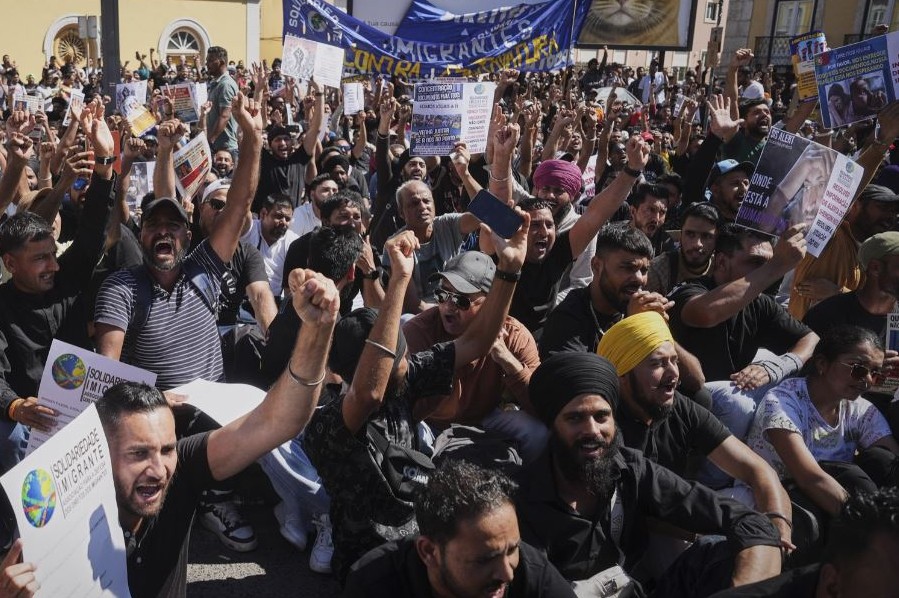
Migrant workers and their demands must be included in the construction of the new general strike!
Two years of AD government have been marked by repeated attacks on the working class. In the face of the erratic fluctuations of global markets, the Portuguese bourgeoisie clings desperately to its profits, seeking to increase its exploitation of the working class, and relies on this government of the capitalists to make the task easier.
Migrant workers have been the main target of this offensive. The stripping of rights from these workers proved to be the path of least resistance to lower wages and attack the rights of the entire working class in Portugal, besides dividing it along national lines, diverting the legitimate outrage of the exploited from the fight against employers and landlords towards other workers, made scapegoats of the living conditions degradation.
Contrary to what the far-right insists, immigration is not the cause of any of the problems that afflict the working class in Portugal, but rather the precariousness and low wages imposed by capitalists, the financialization of housing by banks and large real estate funds, and the remaining inflation caused by major retail capitalists, etc. It is the class interests in having a dignified life without exploitation that should unite us, all workers, in ending the capitalist system, above any social construct created to divide us.
The Portuguese economy and the migrant working class
The phenomenon of immigration in Portugal, although it has always existed, has undergone a quantitative change over the last decade. Between 2017 and 2024, the migrant population in Portugal quadrupled, reaching 1.5 million people, almost 10% of the population.
Behind this change in the social structure of the working class is the development of the economy over the same period. The economic recovery that took place after the years of crisis and austerity, starting in 2015 with the rise to power of António Costa's PS and the 'geringonça' government, was built on the growth of tourism (which in 2024 contributed to more than 20% of GDP), the export of services, particularly related to call centers, and real estate speculation.
The development of these sectors led to economic growth that exceeded the rest of Europe for several years, and even allowed for a positive balance in public finances, a historically rare occurrence in Portuguese accounts. This growth allowed the Portuguese bourgeoisie to offer some social reforms and secure a period of social peace after the class confrontations that marked the period of austerity.
Immigration came in response to the substantial increase in labor demand during that period, particularly in the real estate sector (growth of 107%), in information and communication (103%), in accommodation and food service (69%), in agriculture and fishing (68%), and in construction (57%).
This is confirmed by the fact that these are same sectors that today have a higher percentage of foreign workers: agriculture and fishing (53%), administrative activities, which include cleaning (40%), accommodation and catering (39%), and construction (36%). More than half of migrant workers in Portugal work in these sectors, compared to less than 30% of Portuguese workers.
But not all jobs are created equal, and in most of these sectors, the new jobs created were precarious. In 2023, 80% of the 110,000 jobs created in a year were fixed-term contracts and unstable employment relationships, particularly in the sectors of turism, accommodation, and construction, the same sectors where migrant labor predominates. And indeed, it is confirmed that around 35% of migrant workers in Portugal have temporary contracts, compared to about 15% of the total workforce in Portugal – all of this official data, which is likely to be largely exceeded in the country's irregular reality.
It was the economic growth of the past decade, built on precarious work, that led to the wave of immigration that created the migrant working class we have today. But an economy built on tourism, offshore work, like call centers, and speculation is built on sand.
The crisis of Portuguese capitalism is an inescapable reality, and it will have a much greater impact on the future of immigration than any legislative maneuver. The reality is that, faced with the rising cost of living and low wages, which no longer even compete with those offered in Brazil, the country of origin of the largest migrant community in Portugal, the material motivations for the immigration wave have ceased to exist, and, in fact, the migratory balance has already fallen to almost half in the last two years.
This panoramic analysis is necessary to understand the driving force that leads the far-right, both inside and outside the government, in its anti-migrant legislative action: it is not to end a wave of immigration that economic ruin has already taken the breath out of, but to make the lives of migrant workers who are already in Portugal more difficult and precarious, all so that employers can lower wages and increase profits.

The anti-migrant legislation of the government of the capitalists
Since coming to power in April 2024, Luís Montenegro has led a relentless attack in his campaign against the working class. The jewel of this crown is the labor package, with dozens of measures aimed at further precarizing workers in Portugal. Against migrant workers, specifically, there have been three major legislative attacks over the past two years.
The Foreigners Law (Lei dos Estrangeiros), which came into force in October 2025, limits job-seeker visas to “highly qualified workers,” restricts the possibility of family reunification, and prevents CPLP citizens from entering the country without a visa and requesting a residence permit while already in national territory. The new law also serves to make it harder for migrants to access justice, by imposing the obligation to prove – before being able to even file a lawsuit against AIMA – that there was “serious harm,” in addition to allowing the judge to reject legitimate actions based on AIMA’s lack of capacity to respond.
The Nationality Law (Lei da Nacionalidade), which was approved by the right-wing majority in the Assembly of the Republic in April 2026, makes access to Portuguese nationality for foreign workers residing in the country more difficult, and even more demanding than in several European countries such as France, Germany, Belgium, and even Sweden. But the most controversial aspect of this law is the possibility of denaturalization, the loss of nationality as an accessory sanction to an effective prison sentence of five years or more for crimes committed within 15 years after obtaining nationality.
Finally, there is the Return Law (Lei do Retorno), whose bill has already been approved in the Council of Ministers, but has not yet passed in the Assembly of the Republic. This package of measures is being prepared to facilitate the regime of “coercive removal,” that is, deportation of migrants, extending the maximum detention periods in “temporary installation centers,” entirely similar to the infamous ICE concentration camps in the USA, from 2 to 18 months, while reducing the possibilities and deadlines to file legal appeals against deportation. There are also plans to abolish the voluntary departure notification, which gives a notified migrant 20 days to leave the country, and move directly to the coercive departure regime, that is, immediate detention without appeal.
All these counter-reforms develop in the same direction: cutting the rights and legal security of migrants, forcing them into illegality and obedience, preventing them from fighting, together with their class brothers, for better conditions, against a bourgeoisie that seeks to exploit them to the core.
Denaturalization – the loss of nationality – is an instrument of particular barbarity. In bourgeois law, under which we live, citizenship is a foundation of political and social rights. Along with other measures that strip foreign workers of a range of powers to defend themselves against abuses and attacks, whether from the state or from the employer, this is a measure that puts thousands of naturalized citizens at the mercy of the whims of the courts and employers, that creates first- and second-class citizens, who can see their rights to political participation, to life in the national territory, and to legal security revoked, and that, irrevocably, renders citizenship as a concept useless.
These measures have no other purpose than to make it difficult for migrant workers to improve their living conditions, fight for their rights, and live a full and dignified life in Portugal, with participation in its political life. Measures that only serve to benefit employers, for whom it now becomes much easier to exploit their workers without them having any way to defend themselves.
This is perfectly demonstrated in the elimination of the expression of interest, which allowed migrant workers, already present in Portugal without a regularized visa, to start the process of obtaining a residence permit while already in the country. It was replaced by the so-called “immigration fast track” (“via verde da imigração”), a program exclusive to large companies (with more than 150 employees and more than 25 million euros in annual business) and to employer associations. Employers are responsible for the worker's housing, considered “payment in kind.” A system that puts the worker's life in the hands of the employer, making their entire life dependent on the employment contract, and their salary coming in the form of housing and food, as if they were a feudal serf!
It becomes impossible, given its legislative actions, to try to distinguish Luís Montenegro's government from a far-right government. The PSD's shift to the far right, following in the footsteps of Chega and the most reactionary layers of the bourgeoisie that support it, is complete. All they have to offer the working class in Portugal, whether native or migrant, are more cuts and more losses of rights. If we allow this government to continue, the attacks will follow and will become increasingly violent. The need to overthrow it becomes clear and urgent.
A regime of police and bureaucratic terror
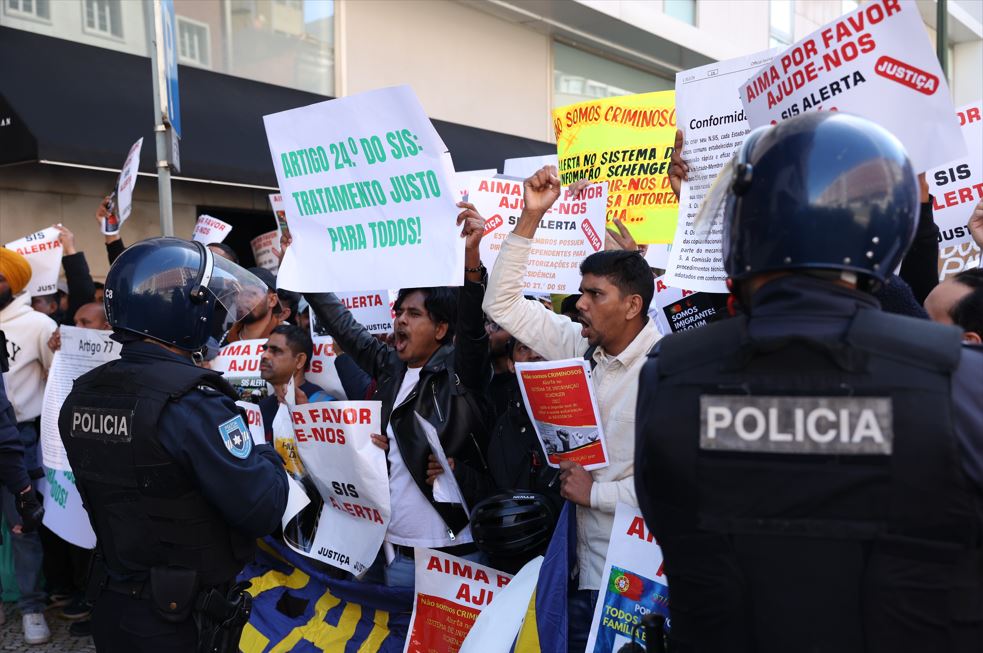
But no matter how terrible the laws that Luís Montenegro and his government conceive are, they are, ultimately, just paper. In practice, it is through the police and its bureaucracy, particularly the AIMA, that the State exerts its violence against the migrant working class.
And, in fact, since coming to power, the Government has led, alongside its legislative activity, a genuine campaign of police terror against migrant communities, particularly in Greater Lisbon. The PSP raid on Rua do Benformoso in December 2024, in which hundreds of people, mostly migrant workers, were harassed by the police for hours, was a starting shot. Throughout 2025, the PSP, inheriting the powers of the SEF, carried out 94 police operations in the Lisbon Metropolitan Area, resulting in the checking of 6,785 foreigners, 30 arrests for illegal stay and other offenses, and 99 notifications for voluntary departure.
These numbers do not include other operations, such as the raid on the Babilónia Shopping Center, in Amadora, in November 2025, which, officially to search for stolen mobile phones, in practice serve as extensions of the police terror campaign against migrants, demonstrations of force in the centers of their communities.
To these operations of public harassment are added the torture that takes place inside the police stations. The investigation carried out at the Rato police station, in which 9 officers have already been arrested for involvement in the cases of torture and rape of two homeless men, continues to reveal victims, mostly homeless people, drug addicts and migrants, to whom all kinds of torture and humiliation were committed with impunity. Far from being an isolated case, it has already been revealed that videos of these aggressions have been shared widely in police groups, where dozens saw and rejoiced at the acts of their colleagues. The case of the Rato police station is, without a doubt, just the tip of the iceberg of the systemic and savage violence that the police practice daily against the most vulnerable elements of society, including migrant workers.
The effects of the Return Law are already anticipated, which will serve as the legal basis to keep migrants detained for extended periods in the so-called 'temporary installation centers,' or CIP. 30 million euros already having been invested to build two new centers, one in Lisbon and another in Porto, to which are added, as a temporary measure, 800 thousand euros spent to purchase 'prefabricated modules,' that is, containers, to house detained migrant families until the new CIPs open. The very choice of containers as an acceptable alternative demonstrates the conditions that can be expected in these future centers.
At the same time, throughout 2025, 23,000 migrant workers received a notification for voluntary departure from the country, 18,000 of whom within a matter of weeks, between April and May of that year. There were tens of thousands, many of whom had already been living in Portugal for years, who were given 20 days to settle their affairs and leave Portugal, a cruelly short period, which is planned to be completely cut.
The furious and relentless speed with which AIMA processed hundreds of thousands of cases, and notified tens of thousands to leave the country, contrasts with the inertia with which they deal with migrant workers who try, on their own initiative, to regularize their situation. The images of people queuing all night to be attended to, sleeping on the floor to secure their place, including the elderly and nursing mothers, only to be treated by obtuse bureaucrats who try to find any opportunity to deny them the consultation and “rush them off,” cannot fail to cause us indignation.
This inhumane treatment of migrant workers cannot be explained by mere inefficiency of resources – it is about consciously making the process by which an migrant can regularize their situation more difficult, in order to leave them more vulnerable to police violence and labor exploitation. It is a machine that is perfectly performing its real task, and which serves the interests of the employers.

A Government complicit in human trafficking and slavery
In November 2025, an exploitation network of 500 South Asian migrant workers working in agriculture in the district of Beja was dismantled. Workers were charged for lodging, in warehouses, and food, and kept working through threats and physical violence. This was administered by eleven police officers, who complemented their "public" functions as rabid dogs of capital with private ones, controlling and assaulting migrants, and receiving between 200 and 400 euros per day for the service.
This case is not the only one, and it reflects the reality experienced by thousands of migrant workers, working illegally in agriculture in the interior of the country, in a situation of slavery or very close, working for accommodation and food, in the most precarious conditions, completely dependent on the traffickers who hold their documents, and under constant threat of, if they do not meet expectations, being assaulted, discarded, and even deported.
These trafficking networks do not exist apart from the Government's policy – they are an integral part of its complex of labor exploitation, including the bosses who hire this slave labor, the policemen who serve as overseers of this slave system, and the Government that legislates in order to make this route the only option for so many migrant workers.
This is the new social portrait of Alentejo, entirely similar to the conditions that existed in that territory during fascism, where agricultural workers lived at the mercy of large landowners. After decades, the Portuguese right finally managed to reverse the collectivization of land and the end of large-scale land exploitation, and to reintroduce, through human trafficking and the removal of legal rights from migrants, the Alentejo plantation regime.
Migrant and national works – general strike until the government is overthrown!
The response that the institutional left has given to the government's attacks on migrants has been clearly insufficient. Between appeals to previous President Marcelo Rebelo de Sousa's 'Christian democratic' values, so that he would veto the government's anti-migrant laws – which, predictably, were ignored – and to individual judges to 'moderate' the application of the law, not resorting to the inhumane rulings of denaturalization and deportation that the new laws allow them, as if the corps of judges were not consistently one of the most reactionary layers of the bourgeois state apparatus.
It also becomes unacceptable, in view of the role that police forces play in carrying out the racist violence of the State against migrant workers, that left-wing parties, particularly the PCP, continue to defend their interests, and that trade union federations continue to accept police unions. Police officers are not 'workers like any other' but rather rabid dogs of capital, and improving the conditions under which they perform the functions of protecting private property, pursuing migrants, and breaking strikes is preventing the working class from having better conditions to organize and seize power for itself.
The results of two years of such opposition to this government speak for themselves: increasingly violent laws, police raids, and increasingly aggressive bureaucratic procedures, and a flourishing of human trafficking and slavery on national territory. It is useless to ask for favors from this government of the capitalists. If we want to put an end to their abuses, we workers have to fight to overthrow it!
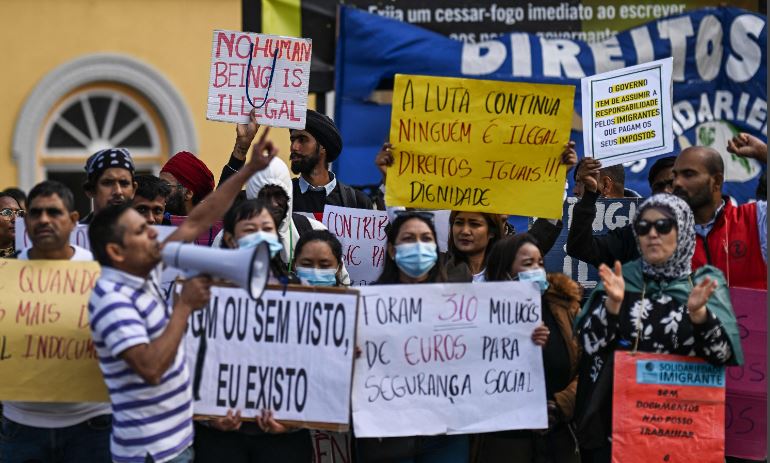
migrant workers make up 24% of the active workforce in Portugal. They are an essential layer of our class for organizing the fight against this government that seeks to facilitate the exploitation of all workers. This reality, particularly in sectors such as agriculture, where migrant workers are the majority, has led some trade unions to make efforts to distribute information to workers translated into English and their native languages, and to elect union representatives from among the migrant communities.
These efforts must be redoubled, and the connections between trade unions, combative left-wing organizations, and migrant communities must be strengthened, through the opening of these groups to the entry of more conscious and militant workers into their bases, and through their training as leaders.
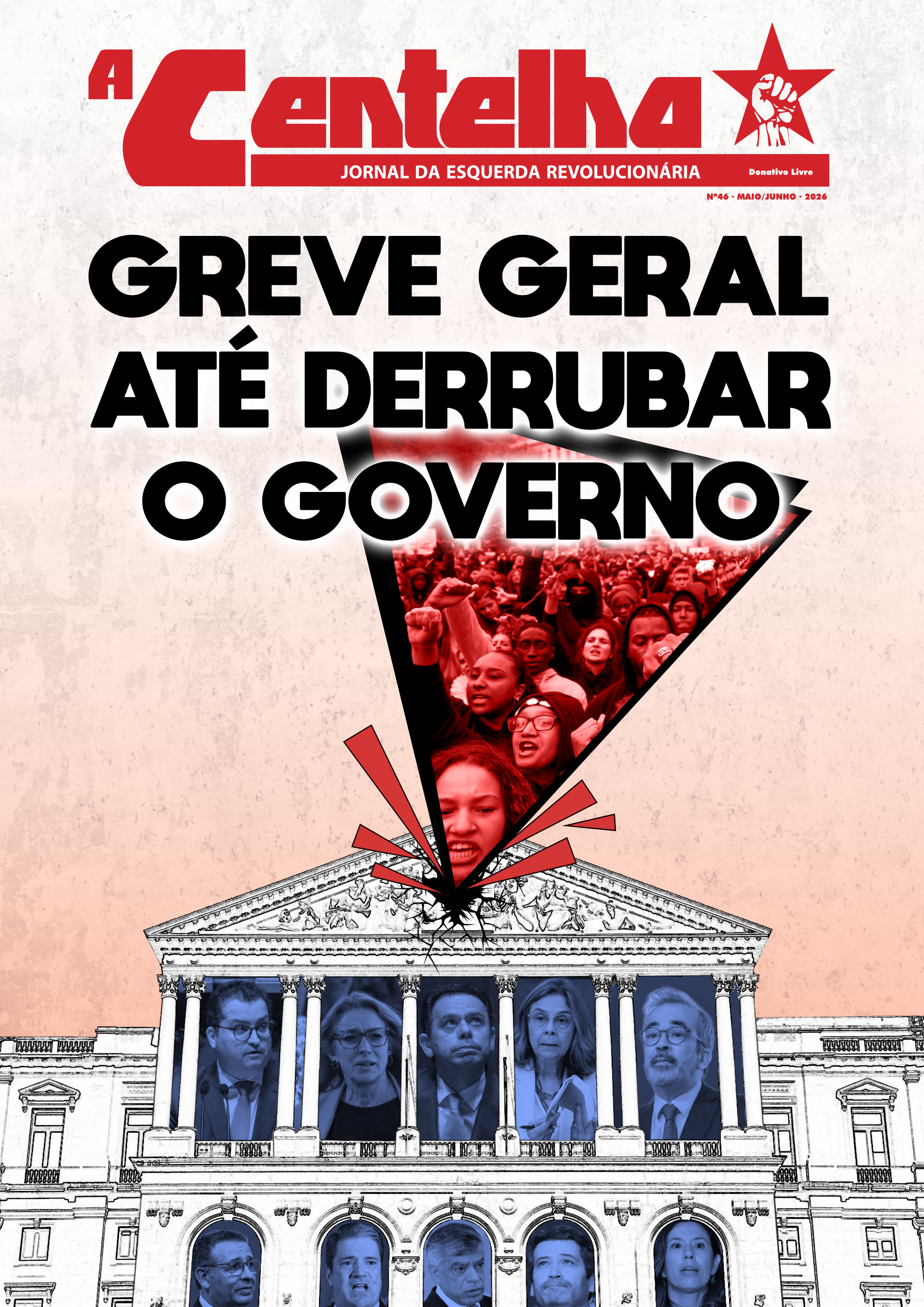
And at this critical moment when the working class in Portugal – both national and migrant– faces the labor package, the most aggressive attack by the Government on all workers since coming to power, it is above all important to be able to unite the working class, including migrant workers, in the call for a general strike. The most conscious elements of our class must relentlessly agitate for a combative general strike, a revolutionary general strike, built from the grassroots and imposed on the leaderships that refuse to fulfill their duty. A general strike that continues until it forces the downfall of this government of the capitalists.
The working class in Portugal faces a fierce enemy in this government. The only way to defend ourselves and to win this fight is to be equally fierce, and even better organized. It is necessary to build the struggle in workplaces, in neighborhoods, and in our communities. And it is necessary to organize our struggle into a unified force capable of fighting for the seizure of power – the revolutionary party.
We defend:
- Regularization of all workers in Portugal, migrants and descendants of migrants, with equal rights to Portuguese citizens and granting Portuguese citizenship to all those who wish it.
- Revocation of the racist laws on Foreigners, Nationality, and Return (Leis dos Estrangeiros, da Nacionalidade e do Retorno).
- Immediate abolition of AIMA and the police forces - constitution of workers' militias to defend ourselves from state and fascist violence.
- Expropriation of the bosses and landlords who exploit us - collectivization of the large fields and nationalization of the big companies under workers' control.
Join the Revolutionary Left (Esquerda Revolucionária) and come build the revolutionary party!
Migrant and national workers – one single working class!